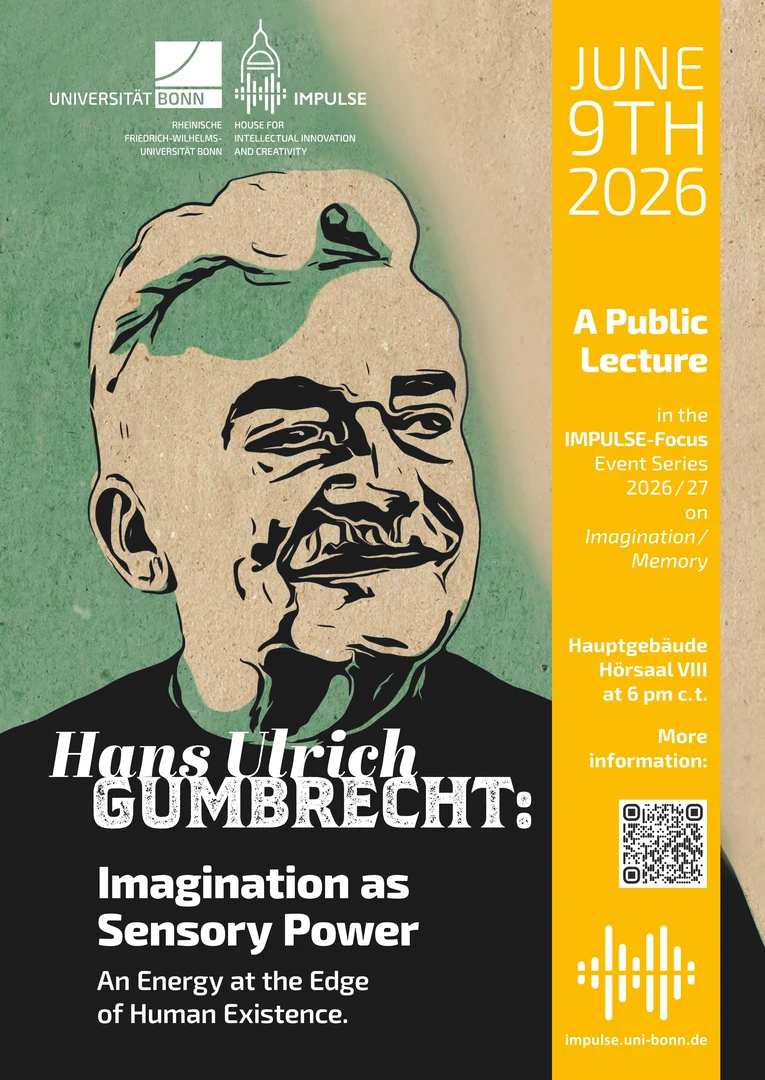
Imagination as Sensory Power: an Energy at the Edge of Human Existence
Over the past few decades, debates among analytic philosophers have brought a new clarity to the broad conceptual field of “imagination” through incisive distinctions, thereby directing intellectual attention to how this faculty is used in everyday life. Seen in this light, any focus on its effects as “sensory imagination” marks a return to classical notions about connections with aesthetic behavior. At the same time, it prompts a new reflection on the status of objects of consciousness, which, despite resembling perceptions in their physical vividness, are not dependent on environmental impressions as perceptions are. How does imagination succeed, to paraphrase a pressing contemporary question not only for scholars of the humanities: how does imagination succeed in suggesting various possibilities for transcending real existence through literary fictions and myths of higher worlds?
Hans Ulrich Gumbrecht studied Romance and German literatures, philosophy, and sociology in Germany, Spain, and Italy. He subsequently taught at the Universities of Konstanz, Bochum, and Siegen. In 1989, he became the Albert Guérard Professor in literature at Stanford University, where he retired in 2018. At the University of Bonn, he holds the status of Distinguished Professor Emeritus. As a scholar, Gumbrecht focuses on Central European and South American literatures and cultures. At the same time, he writes on the Western philosophical tradition, with a particular emphasis on nineteenth- and twentieth-century French and German texts, and seeks to analyze forms of aesthetic experience in twenty-first-century everyday culture. In Europe and in South America, Gumbrecht is also known as a public intellectual. Over the past forty years, he has published about two thousand texts (translated into more than twenty languages) including books such as Production of Presence: What Meaning Cannot Convey, In Praise of Athletic Beauty, and Lives of the Voice. In March 2026 his intellectual autobiography appeared under the title Sepp — Mein Leben auf Halbdistanz.